
Why Most Leaders Confuse Activity With Progress
Activity can not be seen as progress... Progress is Progress. Results are progress.
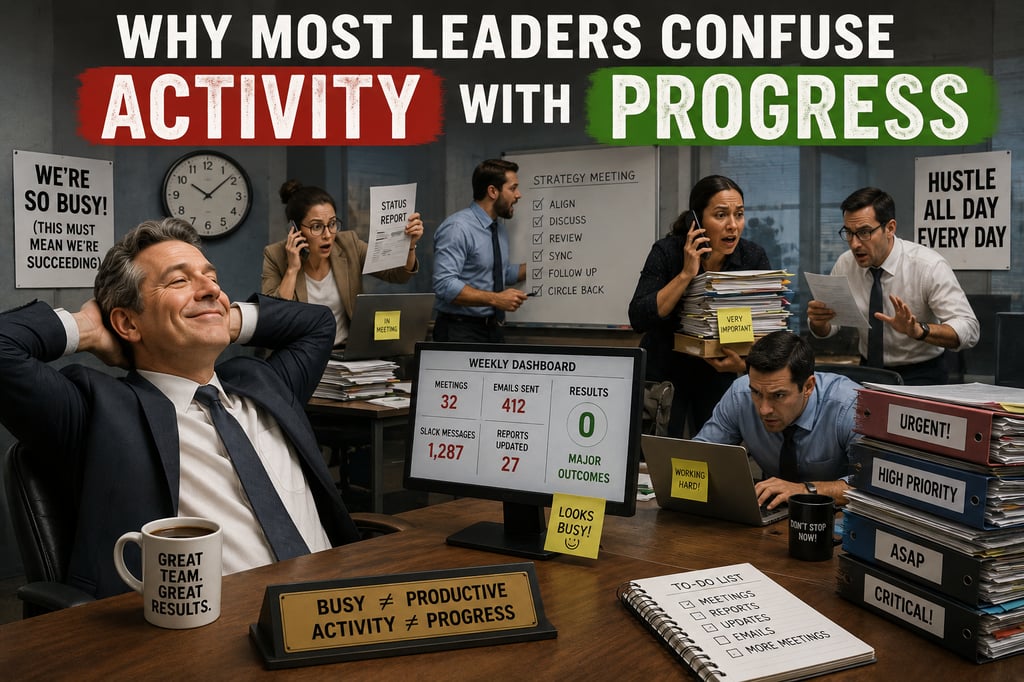
Modern workplaces have become masters of looking productive. Calendars are full. Slack notifications never stop. Dashboards are constantly updated. Teams are jumping from meeting to meeting all day long.
And yet somehow…
Deadlines are still missed. Employees are burned out. Customers are frustrated. And leaders are asking the same question:
“How are we this busy but still falling behind?” Because activity is not the same thing as progress. Somewhere along the way, organizations started rewarding motion instead of outcomes. The appearance of work became more important than the impact of work.
Performative Productivity Is Everywhere
Most organizations today are drowning in performative productivity.
People feel pressure to:
Always appear online
Respond immediately
Attend every meeting
Constantly update status reports
Stay visible instead of staying effective
The result? Teams spend more time talking about work than actually doing work.
I've seen organizations where employees spend:
6 hours a day in meetings
Another 2 hours responding to messages
And then try to squeeze meaningful work into whatever time remains
That isn't productivity. That's organizational chaos disguised as collaboration.
Meetings Have Become the New Safety Blanket
Many leaders believe more communication automatically equals more alignment. It doesn't. Sometimes it creates the exact opposite.
Every additional meeting comes with a hidden cost:
Reduced focus
Context switching
Mental fatigue
Slower execution
Decision bottlenecks
The irony is that many meetings exist because teams are already behind. So organizations respond to slow execution by adding even more meetings. Which creates even slower execution.
Dashboards Don't Create Results
Metrics matter. Visibility matters. Data matters. But dashboards alone do not improve performance. Execution improves performance. Too many organizations obsess over tracking work instead of improving work. Employees end up spending enormous amounts of time feeding reporting systems rather than solving customer problems, innovating, or moving projects forward.
You cannot "KPI your way out" of poor leadership or unclear priorities.
Why Leaders Fall Into This Trap
Because activity feels safer than outcomes. Activity is visible. Progress is harder to measure. A busy team gives leaders psychological reassurance that “something is happening.” But movement without direction eventually creates exhaustion. Not growth, not results.
What Real Progress Actually Looks Like
Real progress usually looks quieter. Focused teams. Clear priorities. Fewer meetings. Hours of deeper work, without distractions. Faster decision-making. Ownership. Accountability. Healthy collaboration without constant interruption.
The highest-performing teams I've worked with were rarely the loudest or busiest; they were the clearest.
5 Questions Leaders Should Ask Their Teams
Instead of asking, “What are people working on?”
Ask more questions like, “What meaningful outcomes are we creating?”
Examples:
1. What work actually moved the business forward this week?
2. Which meetings could have been an email?
3. Where are employees losing focus?
4. Are we measuring activity or outcomes?
5. Are employees clear on the top 3 priorities?
The Best Leaders Protect Focus
One of the most underrated leadership skills today is protecting your team's attention. Focus has become one of the rarest resources in modern business. The leaders who create environments for deep work, clear communication, strategic thinking, and purposeful execution will outperform organizations trapped in endless noise.
Because at the end of the day…
Busy does not equal effective.
And activity without outcomes is just exhaustion with better branding!