
Why Most Corporate Training Initiatives Die Within 30 Days (And How to Keep Them Alive for 6 Months and Beyond)
This blog goes through what most companies experience when they bring in a new training program.
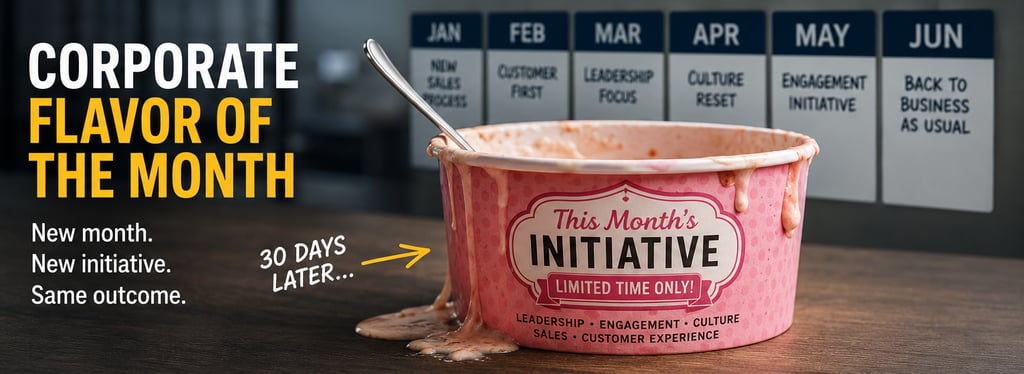
I've worked with organizations of every size—from fast-growing startups to Fortune 500 companies, educational institutions, and government agencies.
One thing I've noticed is remarkably consistent: Everyone loves training at least for the first week.
People leave energized. Managers are excited. Executives are optimistic. New "corporate jargon" gets thrown around. Teams talk about changing behaviors.
Then reality shows up. Deadlines return. Meetings pile up. Priorities shift.
And within 30 days, the training that was supposed to transform the organization becomes little more than a PowerPoint deck sitting in someone's shared drive. Waiting to be casually deleted during the next hardware upgrade!
The problem isn't usually the training itself. The problem is what happens after the training.
The "Flavor of the Month" Syndrome
Organizations often treat training like an event. But sustainable performance improvement requires treating training like a process.
I've seen companies spend hundreds of thousands of dollars on leadership development, sales training, customer service initiatives, culture programs, diversity initiatives, digital transformation projects, and change management efforts only to watch the momentum disappear within weeks.
Why?
Because behavior change is difficult. Knowledge transfer is easy. Behavior change is where organizations win or lose.
5 Reasons Training Initiatives Stall Out
1. Leadership Stops Talking About It
Employees pay attention to what leaders consistently discuss. Not what leaders announce. There is a big difference. When leaders launch a training initiative with enthusiasm but never reference it again, employees receive a clear message: "This wasn't really that important." Culture is created by repetition.
If leaders stop reinforcing the concepts, teams stop practicing them.
2. There Is No Accountability Structure
One workshop does not create mastery. Imagine sending someone to a single golf lesson and expecting them to become a pro. Yet that's exactly how many organizations approach training. Without accountability, most people naturally revert to old habits. We all love the well-worn path of least resistance. People don't usually need more information as much as they need support, reinforcement, and accountability while building new behaviors.
Change is hard for everyone; help them along the way.
3. Managers Were Never Trained to Coach It
This may be the biggest mistake organizations make. The frontline manager determines whether training survives. Managers spend more time influencing employee behavior than any consultant, trainer, or executive ever will. If managers don't know how to coach the new behaviors, reinforce the language, and provide feedback, the initiative dies quickly. Training the workforce without training managers is like buying a brand new computer but letting the employees reinstall the old outdated operating system on it.
"I already know how to use that one!"
4. The Training Isn't Connected to Daily Work
Employees immediately ask themselves one question: "How does this apply to me and the work I do?" If they can't answer that question, any change quickly disappears. People don't change because they learned something interesting. They change because they believe the new behavior helps them perform better, solve problems faster, reduce stress, increase results, or advance their careers.
People are selfish, and that's fine; connect the training directly to real-world outcomes.
5. Success Isn't Measured
What gets measured gets improved. What gets ignored gets forgotten. Many organizations measure attendance. Few measure adoption. Even fewer measure behavior change. And almost nobody measures whether those behavior changes are driving business outcomes. Without visible progress metrics, enthusiasm fades because people can't see the impact of their efforts.
How to Keep Teams Engaged for 6 Months and Beyond
Organizations that create lasting change approach learning differently. They understand that training is not an event. It's a campaign. Here are five proven ways to keep momentum alive long after the kickoff session ends.
1. Create Monthly Reinforcement Sessions
The initial training should be the beginning, not the end. Hold short monthly reinforcement sessions focused on a single concept from the previous training, not another four-hour workshop. Just 20 to 30 minutes of practical application.
Ask questions like:
What's working?
What's challenging?
What successes have we seen?
What adjustments should we make?
Small, consistent reinforcement beats large, infrequent training every time.
2. Equip Managers with Coaching Tools
Managers should become learning multipliers!
Provide:
Coaching guides
Conversation starters
Observation checklists
Feedback frameworks
Discussion questions
When managers reinforce the training during one-on-ones and team meetings, learning becomes part of the culture rather than a separate activity.
3. Celebrate Behavioral Wins
Most organizations only celebrate outcomes. Celebrate behaviors that lead to outcomes. If you're implementing a customer experience initiative, recognize employees who demonstrate the behaviors. If it's a leadership program, highlight leaders who are applying the principles. People repeat what gets recognized. Recognition accelerates adoption.
4. Build Learning Into Existing Meetings
Don't create more meetings. Use the meetings you already have.
Dedicate five minutes during:
Team meetings
Leadership meetings
Department updates
One-on-ones
Ask one question:
"How are we applying what we learned when dealing with X ?" Those conversations compound over time.
5. Make Learning Social
People learn best from other co-workers and they also they learn best when they have to teach something.
Create opportunities for employees to share:
Success stories
Challenges
Best practices
Lessons learned
When team members begin teaching each other, learning stops being dependent on the trainer and starts becoming part of the organization's identity.
The Real Goal Isn't Training
The real goal is behavior change. And the real goal of behavior change is improved performance. I've seen organizations achieve incredible results when they stop viewing training as a one-time event and start treating it as a long-term strategic initiative. The companies that win aren't necessarily the ones with the best trainers, the biggest budgets, or the most sophisticated learning platforms.
They're the organizations that understand one simple truth:
People don't change because they attended training. People change because leaders consistently reinforce, coach, measure, recognize, and model the behaviors long after the training ends. That's where real transformation happens.
And that's how you prevent your next training initiative from becoming just another flavor of the month.