
Why High Performers Quietly Quit Organizations
Why do the best people leave your organization.

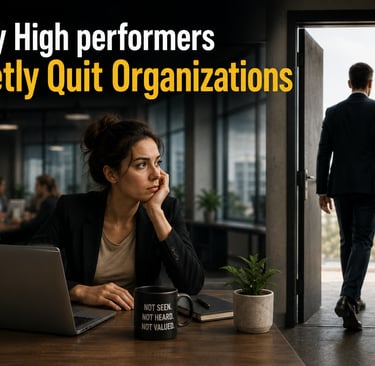
Most leaders don't lose their best employees overnight. They lose them six months before they ever officially quit. The mistake many organizations make is assuming turnover begins when someone updates their LinkedIn profile or accepts another offer. In reality, turnover often begins much earlier. It starts when high performers stop believing things will change. One day they're engaged. Then they're frustrated. Then they're disappointed. Eventually, they become disconnected. By the time they hand in their notice, they've already left emotionally months ago.
High Performers Leave for Different Reasons
Average performers often leave because of compensation. High performers usually leave because of poor leadership.
However, in your exit interview what does everyone says.... they left for more money, but why? Because it's much easier than saying, "I left because this place is a disorganized nightmare and my boss is an incompetent idiot". No one will risk telling the truth.
Secondly, when you leave a job, you always look for a better offer, who leaves to take a pay cut? No one.
Even if your place is not a nightmare, employees have high expectation, and you best employees have even higher ones.
The best employees want:
Growth
Challenge
Recognition
Trust
Purpose
Development
When those things are absent or start to disappear, their commitment starts to disappear too.
The problem is that many organizations focus heavily on retention after employees become disengaged instead of preventing disengagement in the first place.
Burnout Doesn't Always Look Like Burnout
Managers often expect burnout to look dramatic. But high performers rarely wave warning flags.
Instead, they quietly:
Stop contributing ideas
Attend meetings but say less
Become less enthusiastic
Stop volunteering for projects
Focus only on required work
Withdraw from leadership discussions
They still perform. They still hit goals. But the energy is gone. That's often the first sign.
Lack of Recognition Creates Invisible Resignations
One of the fastest ways to lose great people is to assume they know they're appreciated. They don't.
Imagine if you said out loud, "My wife knows she's appreciate... I don't have to say it, she just knows". You would be a terrible husband and a terrible boss if you think that way about your people. "My employees know they are appreciated." or "That's what the paycheck is for".
Anyone with any sense is would hear that and act out the famious Homer Simpson expression... palm to forehead, "Doh"!
Your best employees are like those close intimate relationships and they need the same care and respect. One of the best ways is through regular recognition for a job well done.
Recognition isn't about trophies. It's about being seen. Many top performers become victims of their own success. Because they're reliable, leaders stop acknowledging their contributions.
Eventually they start asking themselves: "If nobody notices the effort I'm making, why keep making it?"
Bureaucracy Kills Top Talent
High performers love solving problems. They hate unnecessary obstacles. We've all been apart of a stupid process that no one was willing to change and it made no sense, but you just had to do it that way.
Que the "Nails on chalkboard".
When employees encounter:
Excessive approvals
Endless meetings
Slow decision-making
Political games
Layers of unnecessary process
Frustration grows quickly. Talented people want to move organizations forward. Bureaucracy makes them feel like they're running in circles.
Employees Want Their Voice to Matter
One of the most common comments I hear from employees who just turned in their two weeks.
"Management never listened there." Not, "The pay was terrible." Not, "The benefits were awful."
Things like, you would tell them a problem, everyone would shake their heads in agreement and then you would be talking about that same problem a month later".
People want their opinions considered. They want their expertise respected. They want leaders who create dialogue instead of monologues. When employees repeatedly share ideas that go nowhere, they eventually stop sharing altogether.
The Signs Managers Often Miss
Watch for these warning signs:
A previously engaged employee becomes quiet
Innovation declines
Participation decreases
Feedback stops coming
Excitement disappears
Collaboration decreases
Career conversations stop
These aren't attitude problems. They're often disengagement signals.
Retention Starts With Leadership
Organizations often spend enormous amounts recruiting talent. Then spend very little developing the environment that keeps talent. The best retention strategy isn't a bonus. It's competent inspired leadership. Leaders who communicate. Leaders who recognize. Leaders who coach. Leaders who listen. Leaders who remove obstacles for their people.
The organizations that keep top talent aren't perfect.
They're simply places where great employees feel valued, challenged, heard, and supported.
And when employees feel those things, they rarely go looking elsewhere.
They don't quietly disengage and then quietly leave.