
The Stupid Mistakes That Push Good Employees Out
Managers do not try to cause turnover, but through stupid preventable mistakes, that's exactly what is happening.

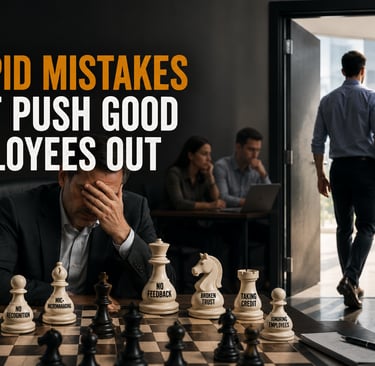
Most employees do not wake up one morning and suddenly decide to leave an organization. They leave slowly. First, they stop speaking up. Then they stop bringing ideas. Then they stop going the extra mile. Then they start doing exactly what is required. Nothing more.
By the time they resign, they have usually been gone emotionally for months. And in many cases, the reason is not the company. It is the manager.
The Problem Is Not Always because of Bad Intentions
Most managers are not trying to drive people away. They are not waking up thinking: “How can I make my team miserable today?” The problem is often simpler than that. They were never trained to be leaders. Many managers were promoted because they were strong individual performers. They hit numbers. They knew the job. They understood the technical side. They were dependable.
So the organization said: “You are great at the work. Now go lead the people doing the work.” That is where the problem starts.
Being good at a job does not automatically mean you know how to lead people.
Technical Skills are Not Leadership Skills
A great salesperson does not automatically become a great sales manager. A great nurse does not automatically become a great department leader. A great engineer does not automatically become a great people leader. A great government employee does not automatically become a great supervisor.
Leadership requires a different skill set. You have to know how to communicate. Coach. Listen. Give feedback. Resolve conflict. Recognize effort. Set expectations. Hold people accountable. Build trust. Handle pressure. Adapt to different personalities.
That does not happen by accident. It has to be taught.
The Stupid Mistakes That Push Good Employees Out
Untrained managers often make simple mistakes that do major damage. They ignore good work because “that’s what the employee is paid to do.” They only communicate when something is wrong. They criticize publicly and praise privately, if they praise at all. They confuse accountability with control.They avoid difficult conversations until small problems become big problems. They promote their favorite employees instead of the most capable ones. They shut down ideas because “we’ve always done it this way.” They give unclear expectations and then punish employees for missing invisible targets.
They assume silence means everything is fine. It does not. Silence often means people have stopped believing it is worth speaking.
The Generational Disconnect
This is where many organizations are struggling right now. The older guard often grew up in workplaces where feedback was direct, recognition was rare, and the attitude was:
“No news is good news.”
Many leaders from previous generations were taught: “Do your job. Don’t complain. Be grateful you have a paycheck.” That approach may have been common. But it does not work the same way with younger generations. Millennials and Gen Z are not necessarily weaker.
They are different.They expect communication. They expect feedback. They expect recognition. They expect purpose. They expect development. They want to know where they stand. They want to know how they can grow. They want to know whether their work matters.
Some older leaders hear that and think: “They need too much praise.” But that misses the point. Recognition is not babysitting. Feedback is not hand-holding. Coaching is not coddling. It is leadership.
Criticism Without Relationship Feels Like Attack
One of the biggest mistakes untrained managers make is giving criticism without first building trust.
Older managers may say: “I’m just being honest.” But honesty without emotional intelligence can feel careless. Younger employees are often more open to feedback than people assume. But they want feedback that is useful, specific, respectful, and connected to growth.
There is a major difference between: “You messed this up.”
And: “Here is what happened, here is the impact, and here is how we can improve it next time.”
One creates shame. The other creates development. Managers who do not understand that difference lose people.
Recognition Is Not Optional Anymore
Some leaders still believe employees should not need recognition.
They say: “I don’t need someone telling me good job every five minutes.”
Maybe not. But leadership is not about what motivates you. It is about understanding what motivates the people you lead.
Recognition tells people: “I see your effort.” , “I value your contribution.” and “Your work matters here.”
When employees do not receive that message, they eventually start looking for a place where they will.
The Quiet Damage of Poor Communication
Poor leadership communication does not always look dramatic.
Sometimes it looks like, delayed responses, vague expectations, last-minute changes, no explanation behind decisions, no follow-up, no clarity, no context, no career conversations, no meaningful one-on-ones.
Employees can handle hard work. They can handle change. They can handle pressure. What they struggle with is confusion. Confusion creates frustration. Frustration creates disengagement. Disengagement creates turnover.
Accountability Is Not Micromanagement
This is another area where untrained managers struggle. They either avoid accountability completely or overcorrect into micromanagement.Neither works.
No accountability creates chaos, too much control creates resentment.
Healthy accountability sounds like:
“Here is the goal.”
“Here is what success looks like.”
“Here is when we will check in.”
“Here is the support available.”
“Here is what ownership looks like.”
Micromanagement sounds like:
“Copy me on everything.”
“Let me approve every step.”
“Why didn’t you respond in five minutes?”
“What are you doing right now?”
Accountability creates ownership.
Micromanagement creates dependency.
Great managers know the difference.
Untrained managers usually do not.
Employees Leave Managers Who Make Them Feel Small
People do not stay long in environments where they feel, invisible, unheard, untrusted, undervalued, embarrassed, stuck, unappreciated, and replaceable.
And here is the hard truth, many managers have no idea they are making employees feel this way.They think they are “just managing.” But their employees experience it as criticism, control, neglect, or disrespect.
What Younger Employees Actually Want
Younger generations are not asking for perfect managers. They are asking for human managers.
They want leaders who, communicate clearly, give timely feedback, recognize effort, offer development listen before judging and explain the “why” behind what they are doing.
They also want leaders who hold people accountable without humiliation and treat employees like adults.
That is not an entitled request, but the use of effective leadership.
The Older Guard Has an Opportunity
Experienced leaders have a lot to offer. They understand resilience. Work ethic. Discipline. Patience. Professional standards. Problem solving.
The goal is not to throw away what previous generations valued. The goal is to combine it with what modern employees need. High standards and strong communication can exist together. Accountability and empathy can exist together. Direct feedback and respect can exist together. Recognition and performance can exist together. The best leaders do not choose between old-school discipline and modern coaching.
They blend both.
Training Managers Is Not a Luxury
Organizations spend huge amounts of money recruiting employees. Then they place those employees under untrained managers and wonder why they leave. That makes no sense. Manager training should not be optional. It should be one of the most important investments an organization makes.
Because managers influence, engagement, employee retention, performance, culture, customer experience, morale, productivity, and trust.
When managers are untrained, the organization pays for it. Not always immediately. But eventually.
The Bottom Line
Employees rarely leave because of one bad day. They leave because of repeated moments that teach them they are not valued. A dismissive comment. A missed recognition opportunity. A poorly handled correction. A lack of communication. A manager who never listens. A leader who only shows up when something goes wrong. Those moments compound. And eventually, good people leave.
Not because they were weak. Not because they were entitled. Not because they could not handle feedback. But because leadership failed to create an environment where they could grow, contribute, and feel valued. The future of work does not belong to managers who simply supervise tasks.It belongs to leaders who can develop people.
And if organizations want to keep great employees, they have to stop assuming managers will figure it out on their own. They need to train them. Because untrained managers do not just make mistakes.
They make people leave.