
Managers Are Burning Out Faster Than Employees
This blog discusses the real challenges managers face and why they are the most likely group to get burnt out.
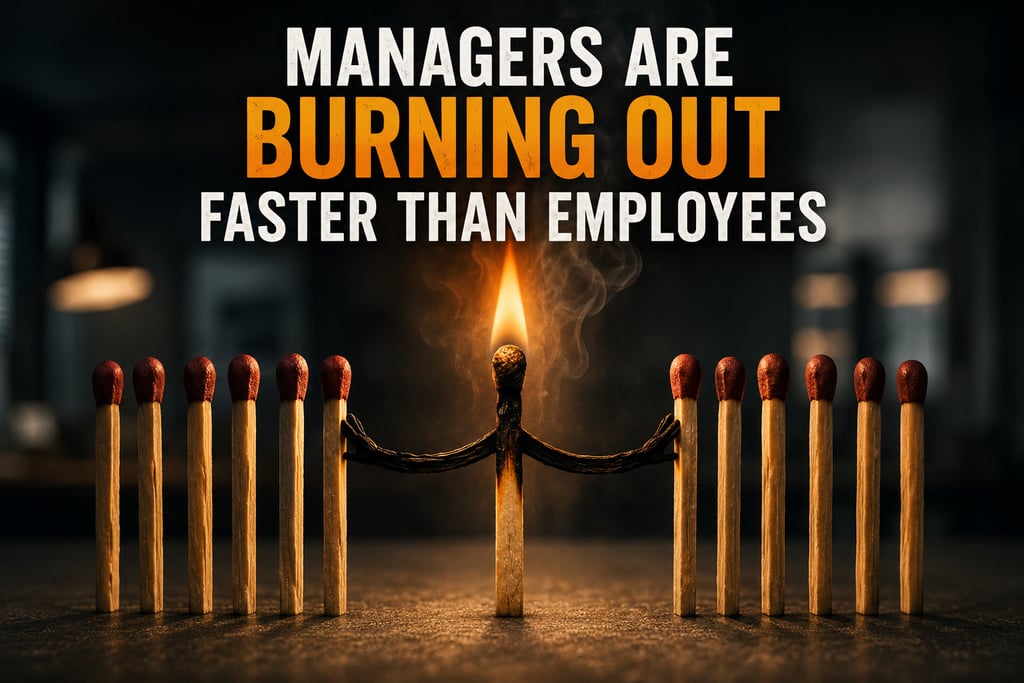
For years now, workplace conversations focused on employee burnout. But ever present and lurking in the shadows has been another problem, manager burnout.
It may be even more dangerous to an organization than any of your other employees, because middle managers are the glue that hold an organization together.
When they burnout it hurts everyone, from top to bottom.
They have somehow becoming the pressure valve for modern organizations. When something needs to get done, they are the ones usually staying late and getting in early. They're expected to drive performance from their teams, while supporting employees in more ways then ever before.
They're navigating competing priorities, constant change, staffing challenges, budget pressures, engagement concerns, performance issues, and executive expectations.
All at the same time.
Clowns to the left of me... Jokers to the right.
Managers often find themselves trapped between two competing realities. What the executive team whats and what their people want.
Executives want:
Faster results
Greater accountability
Increased productivity
Lower costs
Employees want:
More flexibility
Better communication
More development
Better work-life balance
Managers are expected to deliver both. Without additional resources. Without additional time. Without additional support. As they say, when you try to make everybody happy, you make no one happy... including yourself.
Manager's often have to choose between making their bosses happy and doing what they feel is right for their team.
Worse yet is if neither group truly appreciate what the middle manager is having to do to deliver on all those competing interests.
Often their executive bosses are so caught up in their metrics and driving performance, that they neglect to acknowledge the tough spot the manager is put in.
Even their own team may have a false impression that their role is easier by comparison. What they don't realize is the "weight of the crown", is heavy. What might seem "glamorous" or "privileged" is often neither and is more likely about how fast they can shovel the poop each day so they don't drown in it!
Managers Are Carrying More Weight Than Ever
Today's managers are not just simply making sure the work gets done.
They're expected to be:
Coaches
Mentors
Counselors
Conflict mediators
Motivators
Performance leaders
and often producers
Many managers spend so much of their days helping their people deal with issues, that they have no time during the day to do their regular work. Causing late nights and early mornings, just to keep their heads above water. Few organizations acknowledge it.
Constant Change Creates Constant Fatigue
Organizations are changing faster than ever. New initiatives. New technology. New priorities. New expectations. Managers become responsible for translating organizational change into daily execution. Every new initiative becomes another responsibility added to an already overloaded plate.
The Hidden Cost of Burned-Out Managers
When managers burn out, communication suffers, coaching declines, employee engagement falls, turnover increases, decision quality drops., and their team culture weakens.
Burned-out managers don't just affect themselves. They affect everyone they lead.
Warning Signs Leaders Should Watch For
Increased frustration
Reduced patience
Decision fatigue
Emotional exhaustion
Withdrawal from leadership conversations
Less coaching
Higher absenteeism
Cynicism
These signs often appear months before a manager leaves.
Supporting Managers Better
Organizations need to stop assuming managers will simply absorb unlimited pressure. Their bosses often don't appreciate all that needs to be done to run their team successfully and a little appreciation goes a long way.
Support managers through:
Leadership development
Clear priorities
Better communication
Reduced bureaucracy
Coaching resources
Realistic workloads
Most importantly, stop adding new responsibilities without removing old ones.
Great Organizations Protect Their Managers
Managers influence employee engagement more than any policy, program, or initiative ever will.
If managers are overwhelmed, exhausted, and unsupported, the entire organization feels it.
The future of employee engagement may depend on something many companies overlook:
Taking care of the people responsible for taking care of everyone else.